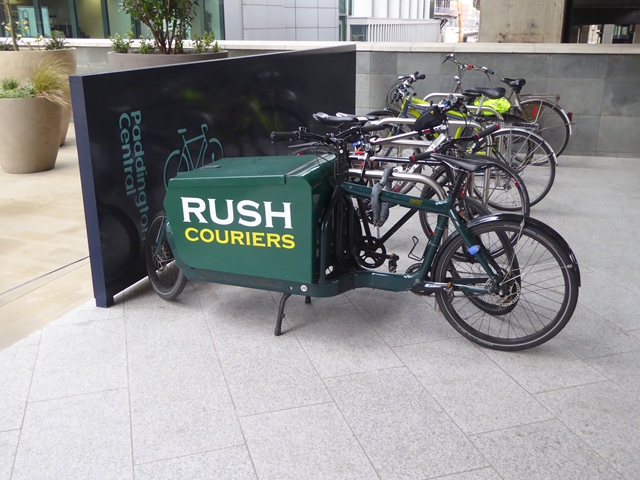
A ladder became the sticking point in an argument about whether cargo bikes could take on some of London’s van journeys. The practical objection was simple: if your work involves bulky tools and building materials, where do they go?
The exchange appeared in an LBC clip dated 1 October 2026, featuring London Assembly member Hina Bokhari and Festus Akinbusoye. Bokhari argued for considering cargo bikes as an alternative for work journeys in the city; the discussion pushed back on whether that made sense for construction work. Akinbusoye’s own public repost of the programme includes the question: “how do you carry a ladder on a bike?”
That is the context for the row. It is a disagreement about what cargo bikes can realistically carry, not a new rule requiring tradespeople to surrender their vans. The useful question is whether a suitable bike can replace some journeys—not whether it can swallow the entire contents of a builder’s van.

Why the ladder matters
A ladder is an awkward load: length and secure attachment matter as well as weight. Mentioning it makes the objection concrete. A working van may also carry tools, supplies and equipment for jobs that change during the day. Those needs deserve a proper answer, rather than a breezy suggestion to pedal instead.
But an awkward load cannot stand in for every business journey. A short visit with a compact tool bag is a different task from moving a cement mixer. These are examples of different transport needs, not claims that either speaker proposed a particular operating plan. Assess the task before choosing the vehicle.
What London’s guidance actually offers
Transport for London published a cargo-bike action plan in 2023 and an operations guide in July 2024. They provide a practical background to this debate; they are not new measures announced by the radio exchange.
The operations guide addresses training, equipment, loading and risk assessment (identifying hazards and deciding how to manage them). It recognises that cargo bikes handle differently from ordinary bicycles and will not suit every rider. That takes the discussion beyond whether a cargo bike exists to whether a particular setup can do a particular job.
Give a real working day a fair trial
For a business considering the option, start with a representative day. What leaves the depot? Which journeys are short enough and have suitable routes? Where will the bike be stored? Who services it, and what happens when the job requires more equipment than expected?
- Check the exact bike’s load limits and secure carrying arrangements.
- Try a representative permitted load on the intended route.
- Include training, maintenance, parking and charging where needed in the costs.
- Keep a suitable alternative for jobs the bike cannot handle.
An empty lap around a shop is not a working trial. Nor should a business have to pretend its biggest load is its only load.
Our view: let the job decide
We favour giving useful cargo-bike journeys a chance. That means taking workers’ practical objections seriously while refusing to turn one ladder into a veto on every bicycle.
A van can remain essential and a cargo bike can still earn a place alongside it. The sensible outcome is a better choice of transport for the job. A bicycle does not have to become a small van to be useful.
Original discussion and official guidance
LBC’s public clip, 1 October 2026 · Akinbusoye’s public repost and transcript · TfL’s operations guide. The public transcript is imperfect; the ladder question is reproduced without expanding it into an unverified quotation. Our examples and assessment are editorial analysis, not reported business trials.
Join the discussion
What has worked for you? Share your experience or ask a question about this article.
Sign in with GitHub to comment. Your comment and GitHub profile name will be public. Comments appear when posted and may be moderated afterwards.
Keep replies relevant and respectful. No spam, personal information or unsupported accusations. Discussion and privacy information.